
Published on
July 25, 2026
Why Visibility Is the New Competitive Advantage
There was a time when advantage was defined by access. Access to capital, access to distribution, access to talent. These were the levers that determined how far and how fast a company could go.
Over time, those levers have become less decisive. Capital is more fluid, talent is more distributed, and distribution is no longer as tightly controlled as it once was. The playing field has not become equal, but it has become more accessible.
What has remained scarce, and increasingly so, is clarity.
Not visibility in the superficial sense of having reports or dashboards, but a deeper, more immediate understanding of what is actually happening across work as it unfolds. The kind of awareness that does not rely on interpretation after the fact, but exists alongside execution itself.
This is the premise Wholistic was built on.
The illusion of visibility

Most organisations believe they have visibility because they have systems in place that produce it. Reports are generated, dashboards are reviewed, updates are shared at regular intervals. On the surface, this creates a sense of order and control.
But what these systems often provide is not visibility, but a representation of it.
Information is summarised, interpreted, and sometimes unconsciously filtered as it moves upward. By the time it reaches decision-makers, it has already been shaped into something cleaner and more digestible than the reality it came from.
This does not make it useless, but it does make it delayed and, at times, incomplete.
In many of the environments Wholistic has been used, this gap is where most decisions quietly lose their edge. Not because the data is wrong, but because it arrives too late or without the full context required to act with precision.
Where execution breaks down
In most environments, work does not fail because people lack direction. It falters in the space between what is happening and what is understood.
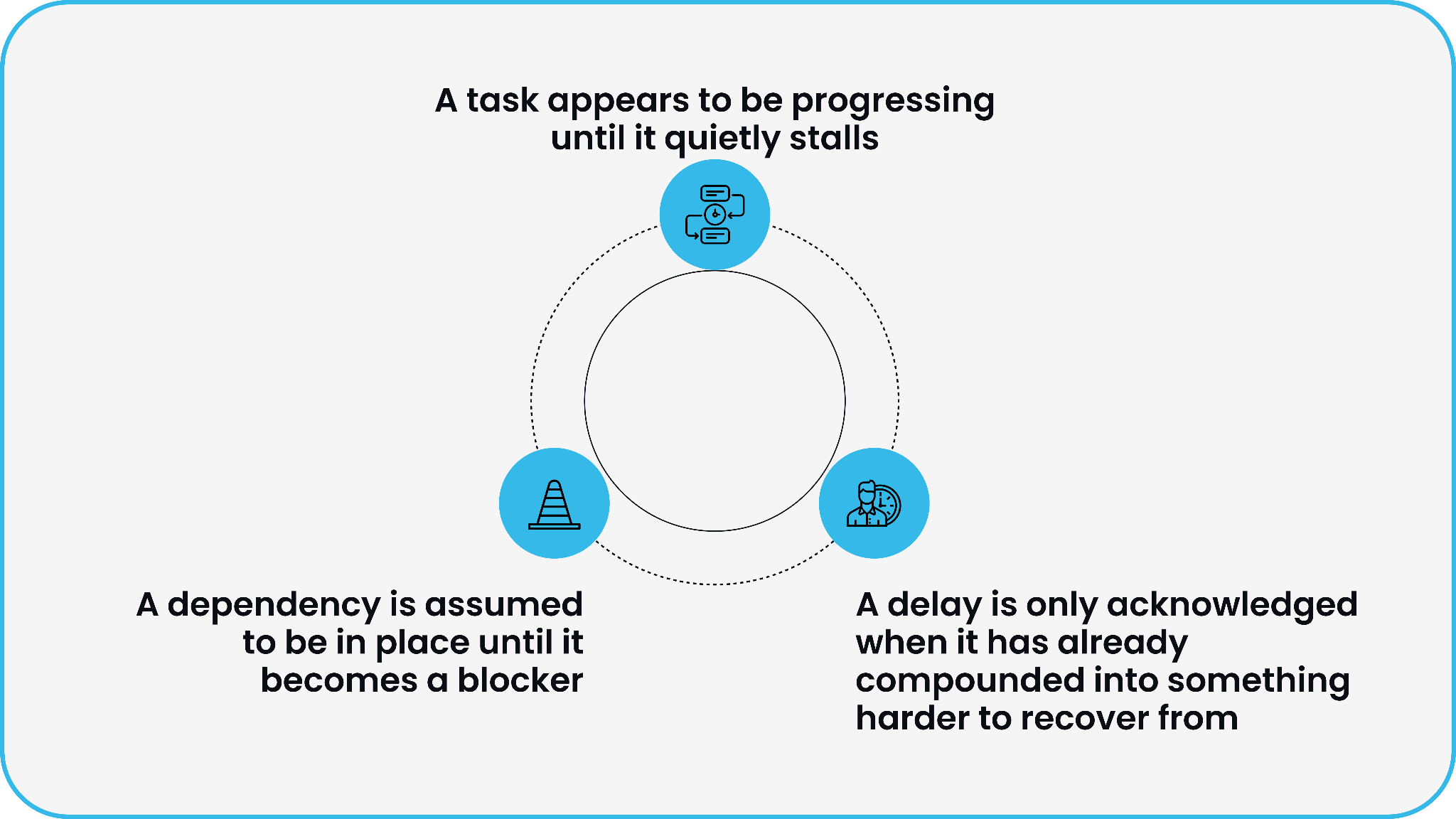
A task appears to be progressing until it quietly stalls. A dependency is assumed to be in place until it becomes a blocker. A delay is only acknowledged when it has already compounded into something harder to recover from.
These are not dramatic failures. They are small misalignments that accumulate over time.
From what we have seen building Wholistic, the issue is rarely effort. It is visibility into the actual state of work while it is still in motion.
What organisations lose is not just time, but the ability to act early, when intervention is still inexpensive and effective.
Visibility as an operational layer
The organisations that move with greater precision are not necessarily those with better plans. They are the ones that maintain a continuous understanding of their work.
This is the shift Wholistic introduces.
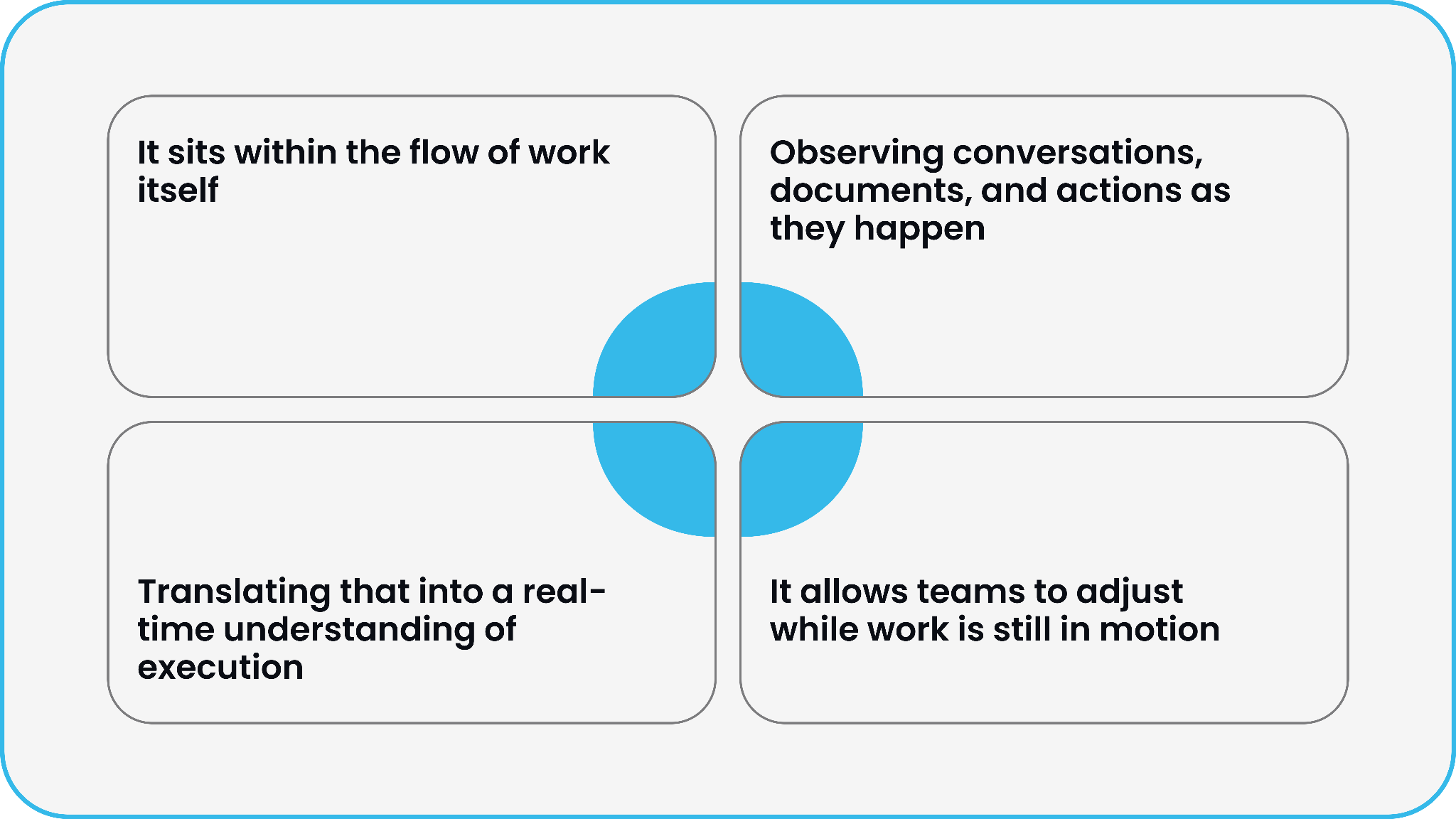
Instead of relying on periodic updates to understand progress, it sits within the flow of work itself, observing conversations, documents, and actions as they happen, and translating that into a real-time understanding of execution.
This changes the nature of decision-making. It shortens the distance between signal and response. It allows teams to adjust while work is still in motion, rather than after outcomes have already been shaped.
Visibility, in this sense, stops being something you review and becomes something you operate with.
Why this compounds into advantage
When visibility improves, its effects are not isolated. They compound across the organisation.
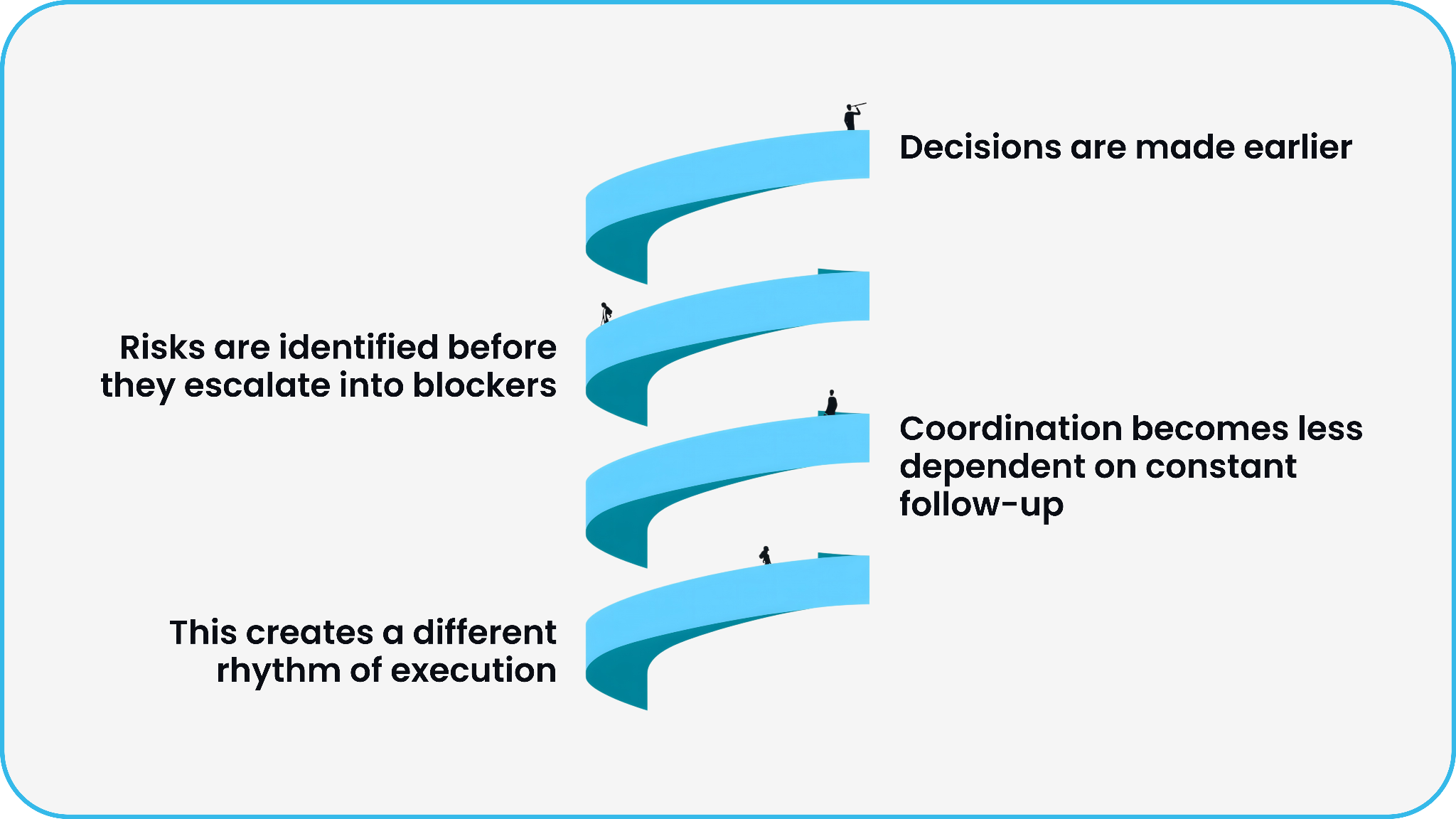
Decisions are made earlier, when there is still room to influence outcomes. Risks are identified before they escalate into blockers. Coordination becomes less dependent on constant follow-up because there is a shared understanding of what is happening.
Over time, this creates a different rhythm of execution. Less reactive, more deliberate, and significantly more efficient.
This is where Wholistic becomes less of a tool and more of an operating layer. It reduces the effort required to understand work, and in doing so, allows teams to spend more time acting on it.
The limitation of traditional systems

Most existing systems are designed to capture and organise work. They provide structure, track progress, and store information in ways that can be retrieved and reviewed.
But they rely heavily on manual input and maintenance. They depend on people to translate activity into structured updates, and in doing so, they introduce a layer of effort that is separate from the work itself.
This is where friction accumulates.
Because the act of keeping the system accurate becomes work in its own right, and over time, it competes with the actual execution it is meant to support.
Wholistic was designed to remove this dependency. Not by adding another layer of input, but by reducing the need for input altogether.
Visibility through understanding, not aggregation

The shift is not towards better dashboards or more detailed reports. It is towards systems that can interpret work as it happens.
Wholistic approaches this by making sense of activity across tools and interactions, and turning that into a coherent, real-time understanding of what is going on.
This is why interaction with the system changes.
Instead of navigating information, you engage directly with Jarvis, asking questions in plain terms and receiving answers grounded in actual context.
The system is no longer something you update. It becomes something that understands.
Category shift: from management to awareness
What emerges from this is not just an improvement in how work is managed, but a shift in category.
From systems that require structure to be imposed before they can function, to systems that derive structure from work as it happens. From tools that depend on input, to systems that generate understanding.
Wholistic sits within this shift.
It moves project delivery away from manual coordination and into continuous awareness, where visibility is not constructed after the fact, but exists as part of the work itself.
The real question
Most organisations are still focused on improving how they manage work.
The more consequential question is whether they can truly see it.
Because in environments where execution is distributed, fast-moving, and dependent on multiple variables, the ability to maintain clear, real-time awareness is not just operational.
It is a defining advantage.


Ready to bring your best work together?
Sign up today and experience how Wholistic can transform your team's productivity!


