
Published on
August 6, 2026
The Future of Delivery: From Manual Oversight to Intelligent Systems
There is a kind of delivery work that rarely makes it into the project plan.
It is not the task itself. It is the checking around the task. The follow-up before something slips. The clarification before a small misunderstanding becomes rework. The message you send because a dependency has gone quiet. The question you ask because an update sounds fine on paper, but something in it does not feel settled.
In What Execution Really Looks Like Behind The Scenes, we talked about execution as the work that happens beneath the visible layer: the coordination, context, and constant adjustment that keep delivery moving. This article builds from that same reality, but looks at the next question: what happens when that hidden layer becomes too much to manage manually?
For a long time, teams have managed this layer through human oversight. A project lead remembers what was agreed last week. A founder connects one delayed decision to three things that will be affected next. A product manager follows up because a blocker was mentioned casually in a thread but never made it into the project board. In many teams, delivery still moves because someone is quietly holding the whole picture together.
That has worked for a while. But it is becoming harder to sustain.
Manual Oversight Is Becoming the Bottleneck
The problem is not that teams are lazy, careless, or unwilling to communicate. Most delivery teams are already doing a lot. They are updating tools, joining meetings, writing reports, replying to messages, checking documents, and trying to keep clients or stakeholders informed.
The problem is that all this activity does not always create clarity.
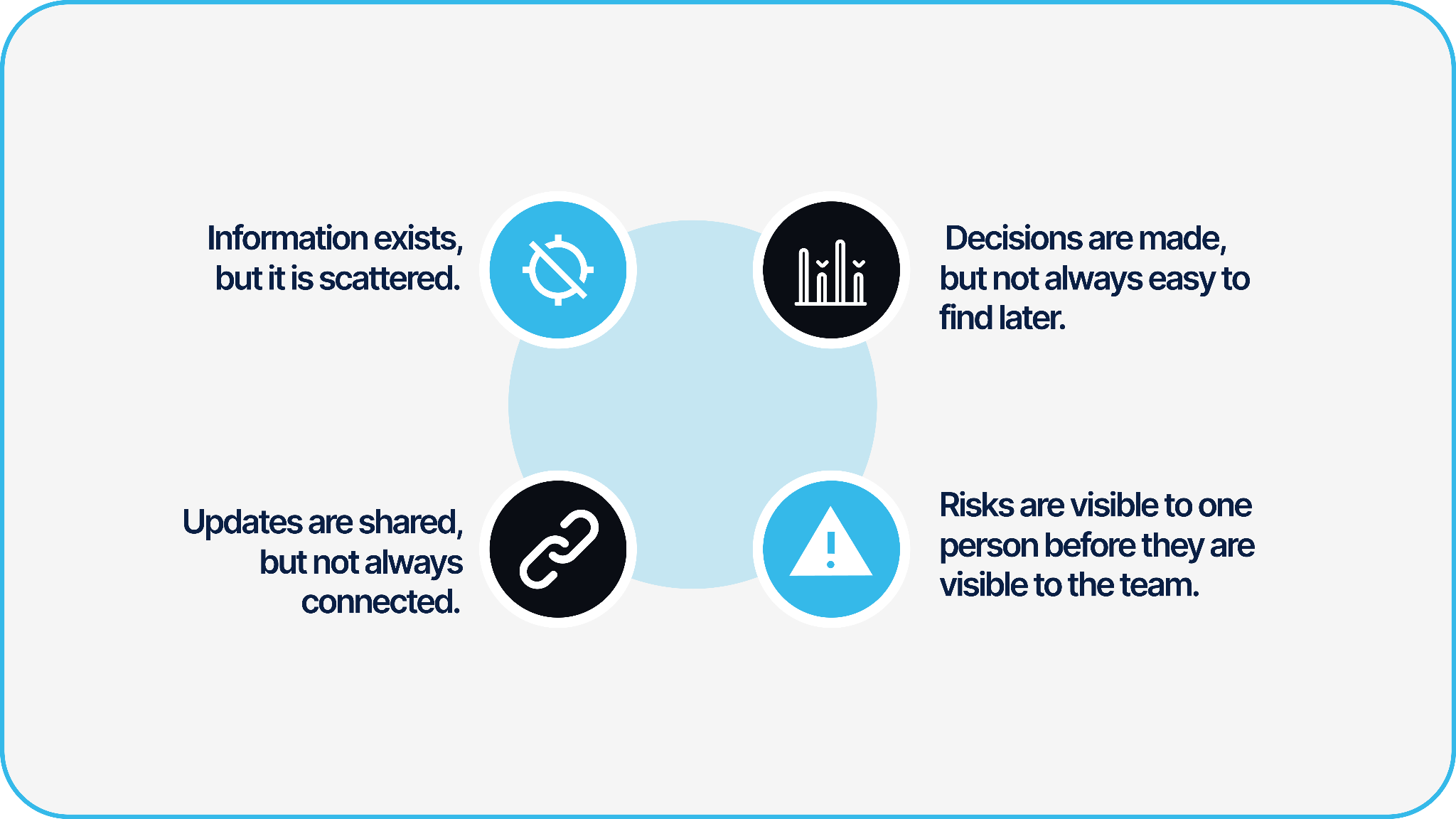
Information exists, but it is scattered. Updates are shared, but not always connected. Decisions are made, but not always easy to find later. Risks are visible to one person before they are visible to the team. By the time everyone understands what is really happening, the work may already have started to slip.
This is not just a feeling. Atlassian’s 2025 State of Teams research found that teams and leaders waste 25% of their time searching for answers, despite having more information available than ever. Asana’s research on “work about work” also found that knowledge workers spend 60% of their time on coordination, status checks, meetings, tool switching, and searching for information.
Those numbers are important because they show the real cost of manual oversight. It is not only the time spent doing the work. It is the time spent trying to understand the work well enough to manage it.
And that is where many delivery systems still struggle.
More Input Is Not the Same as More Understanding
When delivery starts to feel unclear, the usual response is to ask for more structure. More updates. More reporting. More check-ins. More fields to complete. More places where people can show what they are doing.
Sometimes that helps. But often, it only moves the burden around.
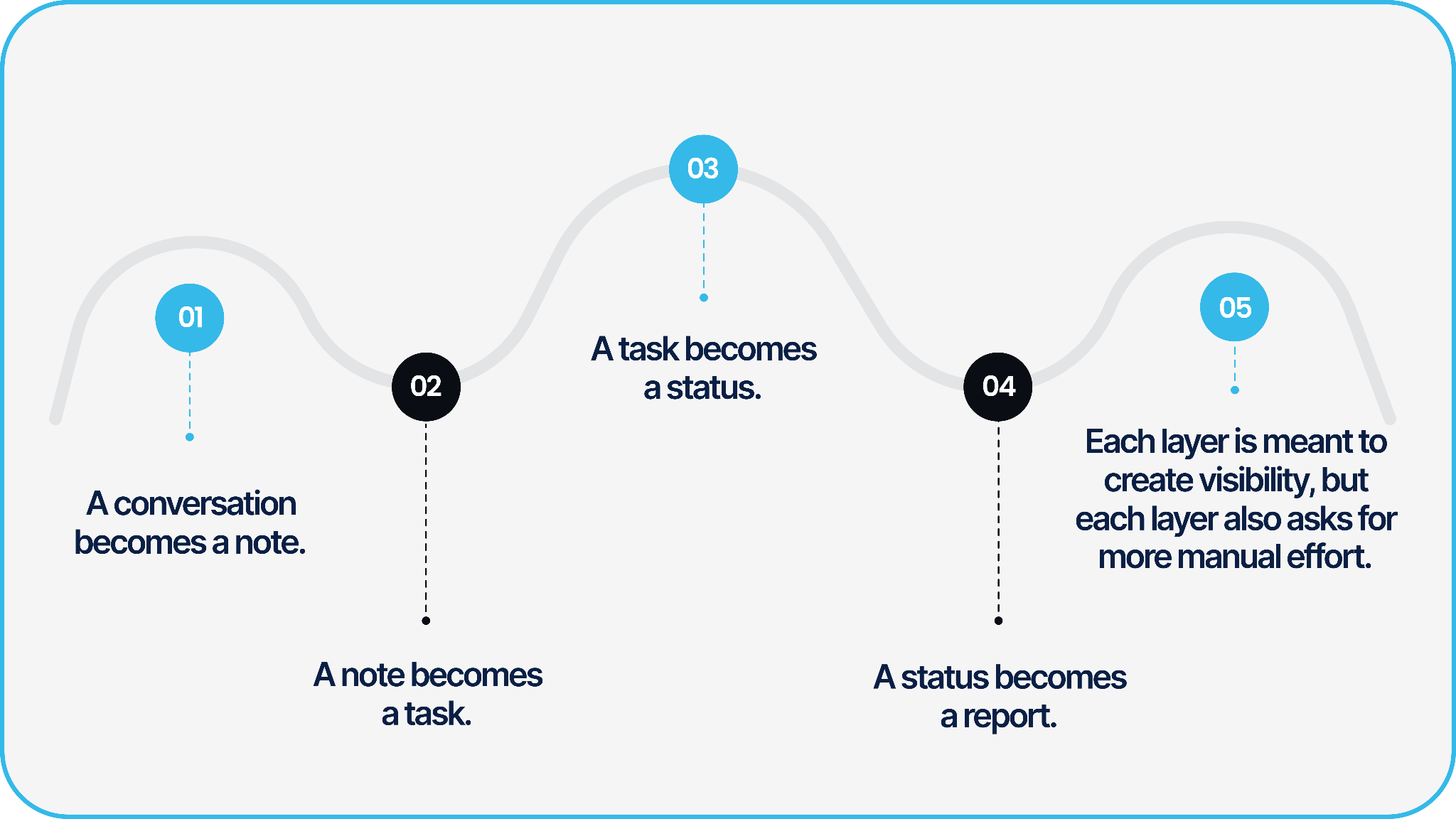
The team is still doing the work, but now they are also translating the work into a format the system can understand. A conversation becomes a note. A note becomes a task. A task becomes a status. A status becomes a report. Each layer is meant to create visibility, but each layer also asks for more manual effort.
This is where the gap begins. What is happening in reality and what is visible in the system are not always the same thing. A project can look organised and still be fragile. A report can look complete and still miss the context that matters. A task can be marked as moving, while the real blocker sits somewhere else entirely.
The future of delivery cannot simply be about asking teams to keep entering more information. It has to be about helping teams understand the information they already create as they work.
What Intelligent Systems Should Actually Do
This is where intelligence becomes useful, but only if it stays close to the real problem.
AI should not be treated as a magic layer that fixes delivery by itself. It should not replace the judgement of the people responsible for the work. It should not create another black box where teams are expected to trust a recommendation without understanding where it came from.
In delivery, intelligence should do something more practical. It should reduce the effort required to stay aware.
That means helping teams notice risk earlier. Not by turning every delay into an alarm, but by recognising when something needs attention: a dependency that has not moved, a decision that keeps coming up without resolution, a blocker that appears in different places, or a gap between what was agreed and what is now happening.
It also means helping teams move from awareness to action. A useful system should not just show that something is unclear. It should help the team understand what to do next: clarify ownership, follow up on a dependency, summarise a decision, or escalate something before it becomes more expensive to fix.
Most importantly, intelligent systems should help with context. Delivery does not only break because people do not have updates. It breaks because people do not have the right understanding at the right time. What changed? Why does it matter? Who is affected? What decision led here? What is still unresolved? These are the questions that usually send people digging through chats, documents, reports, and project boards.
A better system should reduce that digging.
Where Wholistic Is Taking This
This is the direction Wholistic is building towards: not replacing the human work of delivery, but reducing the manual strain around it.
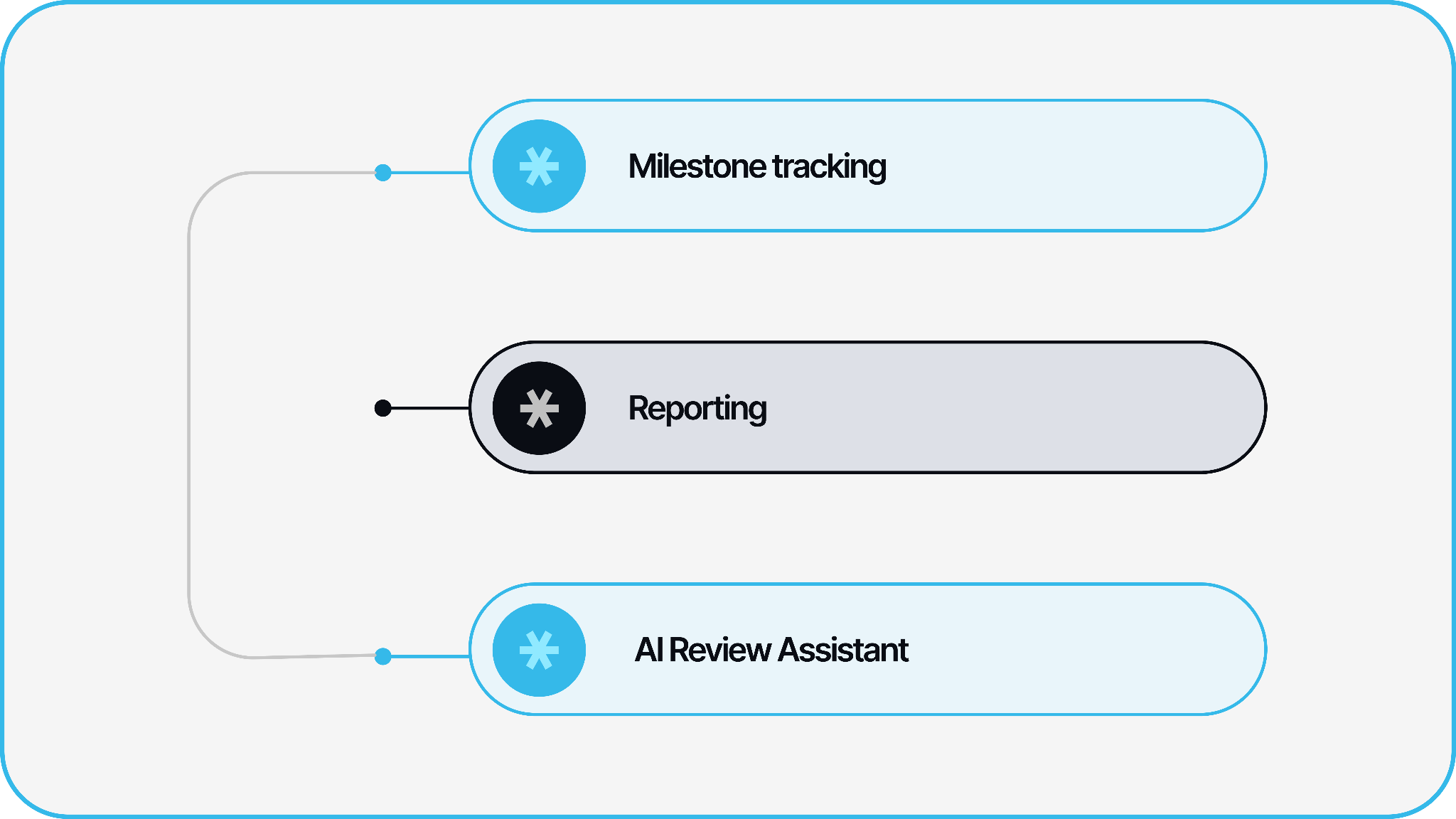
That starts with visibility. Recent updates shared in Wholistic Pulse show how this is taking shape inside the product. Milestone tracking is one example. It gives teams a clearer way to organise delivery around the progress points that matter, without forcing them into heavy project management structures. The aim is simple: make the state of delivery easier to see without depending only on memory, meetings, or manual chasing.
Reporting is another place where this shift matters. In many teams, reports are not difficult because people have nothing to say. They are difficult because the useful context is spread across updates, resources, decisions, and activity. Wholistic’s AI-generated reports are designed to turn that available project context into a structured draft that teams can review, edit, and personalise. The report is not the final judgement. It is a starting point that reduces the blank-page work and helps teams spend more time refining meaning instead of gathering fragments.
The same thinking sits behind the upcoming AI Review Assistant. Writing a report is one thing. Knowing whether it meets the right standard before it goes out is another. A review layer can help teams check reports against their own expectations, reduce bottlenecks, and improve confidence before updates are shared with clients or stakeholders.
Even the future work around MCP support points to the same idea. If AI-assisted actions are going to be useful in delivery, they need to happen with context, permission, and control. Creating updates, preparing reports, or interacting with delivery information should not become another disconnected workflow. It should happen inside the environment where the work already has meaning.
The Next Stage of Delivery
Manual oversight has carried delivery for a long time. It has helped teams survive unclear requirements, shifting priorities, quiet blockers, and all the small things that do not show up neatly in a plan.
But it should not have to carry everything alone.
The next stage of delivery is not about removing people from the process. It is about building systems that support the awareness people already bring. Systems that help teams see earlier, understand faster, and act with less friction.
Because strong delivery has never been only about completing tasks. It has always been about knowing what is happening clearly enough to keep the work moving.
That is the shift from manual oversight to intelligent systems. Not less human delivery, but delivery with better support around the human work that makes it possible.


Ready to bring your best work together?
Sign up today and experience how Wholistic can transform your team's productivity!


